Friday, February 22, 2008

Mini milling table

Marv Klotz posted about a small milling table he made:

Most of the parts I make are small to tiny and fit nicely into my small Eron milling vise. Nevertheless, the odd part will come along that won't and I really hate to remove the vise in order to table mount the part, then have to spend time reinstalling and tramming the vise again.

So I built a small, auxiliary milling table that looks like this.


The table is 1/2" thick aluminum and the bottom is fitted with a machined block that can be grasped in the milling vise.


Most work can be clamped directly to the table using the T-slots. The removable fences allow the work to be aligned to the edges of the table which, in turn, are aligned to the x and y axes of the mill when the block is clamped in the vise. Making the fences removable (after the workpiece is clamped in place) ensures that they won't be damaged during the machining operations.

I had thought of drilling an array of tapped holes in lieu of the T-slots but came up with something a bit more flexible. I had acquired some tooling plates that were perforated with holes exactly the right size for tapping 1/4-20 or 6 x 1 mm (for Unimat accessories). I took a piece of this plate and squared it so it can be located accurately using the fences. Then the edges of the perforated plate act as additional part alignment features and the tapped holes can be used for clamping in almost any location.

Mini indexing table

Marv Klotz posted info about his small indexing table here and here.

Says Marv:
I occasionally need to mount a small part on a faceplate so I made a tiny one to fit into a 1" collet.


The T-slots were made with a 1/4" mill reground to look like a T-slot cutter. The T-nuts are 6-32. The back view,


shows the spigot used to mount it in the collet. The spigot is removable


and has a precision centering pin so that other fixtures can be fitted to it. (A sacrificial mounting plate is shown on the right.)

Finally, with the spigot removed, the faceplate fits into my vertical collet holder (described in an earlier post) to form an indexing table. The bushing shown fits into the table's central hole to reduce its diameter if working on parts smaller than 1/2" OD.


And from the earlier post:


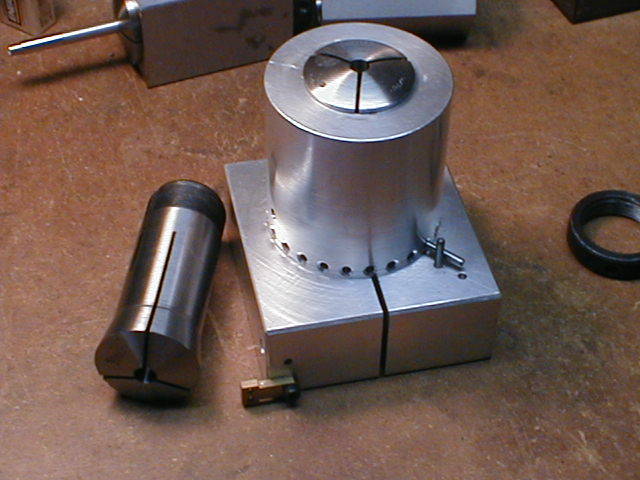
It's a cylinder that holds a C5 collet either vertically or horizontally in the milling vise and provides for 15 degree dividing. The base locks either under vise pressure or via an included (not visible) locking screw. A small stop permits accurate repositioning.

This same base accepts the small rotary table (also capable of 15 degree dividing) mentioned in an earlier post.

Since 90% of the parts I make that require dividing fit into a collet, I find this arrangement very useful for most of my work.

A (internally) threaded ring in a recess in the back of the indexer pulls the collet in to tighten it. This ring has slots into which lugs on a custom made cylindrical wrench fit. This arrangement allows the collet to be tightened with a long piece of stock in it that projects out of the collet rear.

The threaded ring is in a recess so that, when tightened, the indexer can sit flat on its bottom in the vise. There are probably other and better ways to do it but that arrangement worked for me.